
Friday, July 9, 2010

TRONDHEIM TO ANDALSNES BY RAIL



Thursday 8th July 2010
The Trondheim to Oslo regional express left right on time at 8:25 am. It was a sleek modern train which looked rather like the interior of a modern jet airliner. The main differences were the generous space between rows and the large panorama windows. My seat number 29, again proved to be a window seat. So I had good views of the route travelled.
Beyond the city area, the farmland was wide and genteelly rolling. The farms all looked well groomed and prosperous. On this trip, not only did I see several small herds or cows (white ones, brown ones and spotted ones) but also several small flocks of sheep which were grazing on some rougher hill side grass land away from the coastal lowlands.
Once again though, this trip was to take me up into the mountains and along river valleys. Some were narrow with just room for a road the river and the rail higher up the hill side.
From time to time the train briefly stopped at stations. Some seemed remote from anywhere. One thing about these stations though was the manner in which the buildings were all well maintained and that they had colourful decorations painted on above doorways and windows. They had that 'storybook Norwegian look' about them.
At one stage we arrived into high landscape that had the ' I am covered with snow in winter look' about it. Much less vegetation and rounded bare stone areas. A few cabins but not as many as you would expect. Perhaps this is too far to come to ski? As we travelled along the guard announced over the PA system that we had reached the highest point on this line. I know it was over 1000 metres and I believe it was 1025 metres. Quite soon after this we travelled past several small mountain lakes.
I didn't take very long to be back into the tree line again and also areas of farming where there was sufficient flatter land to carry it.
We did pass a lot of wider flatter land given over to farming. There were small settlements and an occasional church.
Finally, after three and an half hours travelling and again in at a higher altitude, the train pulled into Dombas, which was where I was to disembark and have a 30 minute wait for my connecting train.
Actually I realised that the connecting train was standing there but was waiting for the express from Oslo to arrived. So I went into the waiting room and filled the time in typing some of the previous day's blog. Seated at one side of the waiting room were a couple of older women chatting happily away. As it was difficult not to listen, especially as they were speaking in English and that they mentioned terms like 'the South Island' I had to assume that they were New Zealanders. Later I was to prove this correct.
At the ticket counter a Frenchman was attempting to re organise his group's itinerary. It sounded like he had made a planning mistake and was attempting to correct it. From time to time buses called in to drop of or pick up tour parties.
Finally the Oslo to Trondheim express arrived and it was time to board the train to Andalsnes. This was what New Zealand used to call a rail car, except that it had two large carriage units. I was in the second one which somehow had the number 3. Once again this was up to aircraft standard although the seats were not as wide as the ones on the express. Fortunately no one sat beside me. It was all allocated seating. As with all the trains I have been on in Norway, this unit also had a small snow plough attached at the front.
My seat was again a window one but backward facing. Because it was near a wall in the compartment I had more space and was able to place my bag there without restricting my leg room.
Just before we took off the guard came through to hand out descriptive leaflets. Then I remembered about the line.
I was on The Rauma Railway, 'The Most Beautiful Train Journey' they claim. The claim would be hard to challenge.
Essentially the hour and bit long route travelled from 600 plus metres to 4 metres above sea level at the fjord side town of Andalsnes. Along the way there were some technical marvels of railroad engineering to be experienced.
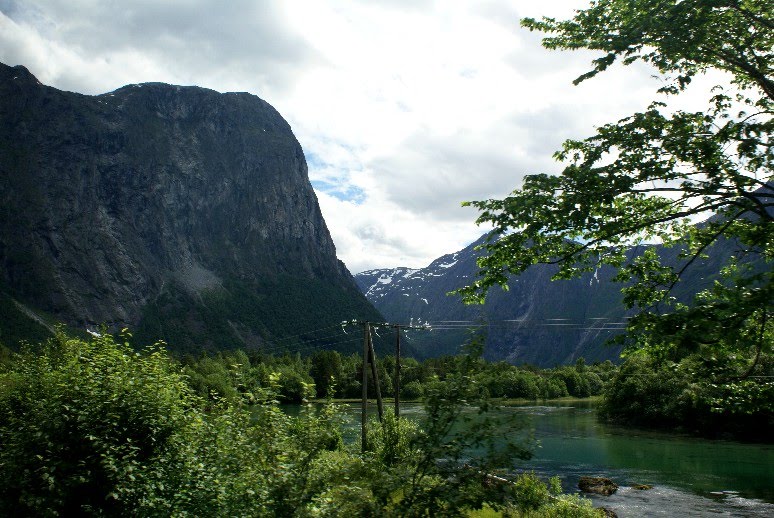
At first was just travelled fast along but above, a fairly wide valley. This was a rich looking farming area. I guess at some stage the valley had been carved out by a glacier as on the opposite side I could see the high sides typical of a glaciated valley. We gradually came down to the valley floor and ran along side an 11 km long lake. The interesting thing here is that it is the division between east and west Norway. A river flows out of each end of the lake. One drains east while the other drains west. We were to follow the west river down to the sea. On the way it carved out narrow steep sided valley and gorges. There were several spectacular water falls coming right down from the mountain summits to the valley floor. Plenty of water in them too.
Because of the steepness, the high rock faces and the narrowness of the terrain, the railway construction had a lot of problems to face. So the rail route does hair pins across the valley and in one tunnel it does a turn to come out facing the opposite direction but only a few metres above the entrance it went in at.
We past the Troll Mountains. Actually we stopped for photos as the train did at several special points. The Norwegian legend has it that these mountains are actually Trolls. Trolls that were caught by sunlight and transformed into mountains. Here there is the highest perpendicular rock face in Europe. The total drop is 1800 metres and yes it did look spectacular. It was only climbed for the first time in 1965. However there is a roadway that goes up at the back behind the mountains and BASE jumpers like to use it to leap off the top. However, this is now banned following several accidents. And I suppose that it would not be a good idea to have the train passengers watching someone kill themselves.
Finally we were down to sea level. The river which had been a white water kayakers challenge further up was now a genteelly meandering flow. Apparently it is a famous salmon fishing river. Then I was able to catch sight of the small destination township. It only has a population of around 3000, but today a large cruise ship was in port and the population must have jumped by at least a couple of thousand more.
Beside the railway station and a few shops and cafes there is not a lot to the town. But the scenery in the fjord was pretty top notch and right out of the picture books. It looked good and looking up at the high mountain sides around me was rather special.
The HI Hostel was a 20 or so walk from town into the county but I had noted that one bus went past it. That bus was parked across from the station and ready to go, so for 13 NOK I was able to get a ride right to the hostel driveway. The driver even pulled right across the road so that I would not have to cross it. That was considerate.
This was one of the original Norwegian hostels and that building still stands, but there are more modern buildings in use now. The first floor, male dorm I was in had six beds. The showers and toilets were close and there was a guest kitchen. On the ground floor was reception a lounge and dinning room for the included breakfasts. There are a couple of other accommodation blocks as well and they are similar except for the ground floor services.
I arrived off the bus just as the Kiwi ladies arrived in their taxi. We struck up conversation quickly and later walked back into town together. There are sisters. One lives in Taupo but the other now lives in Florida. They meet up often by travelling together and on this trip have been going almost as long as me. They started with five weeks in Greece and the Greek Islands which sounded fantastic and was just ahead of the tourist rush. They said it was cheap but they did have a lot of salads. I sounds like they have been travelling extensively for years and have even been to Albania, Rumania and Bulgaria although they indicated that it had not been quite as easy there.
One of the men in the dorm is an architect from Uruguay and another is a man from Poland. I had a good chat with each and with both together.
Oh and the hostel had a laundry. So for 25 NOK I put a wash through -twice! Front loading machines and me are not compatible. It seemed to have finished but I could not get the door to open. As a result I ended up restarting the whole cycle again. Then I got the door open at the end. What was the difference? I do not know. However the clothes are clean and dried out on the line.

Thursday, July 8, 2010


TRONDHEIM CATHEDRAL


Wednesday 7th July 2010
I spent most of today in church. Not really intended, but that is the way it sort of turned out.
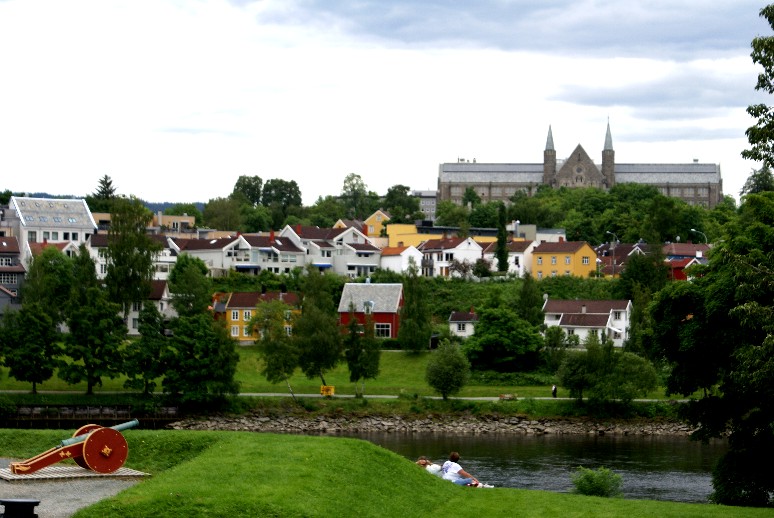
I had already passed the cathedral a couple of times and have been impressed by the huge front wall of the building. It rises high with several rows of at least life sized statues spread across it. Yet despite the great size of the front wall, the actual entrance door is tiny.
In many ways the cathedral is the heart of the city. It is actually called Nidaros Cathedral, with Nidaros being the original name of the town site. It is the largest church in Norway and the largest in fact in Scandinavia. It is the most northern cathedral anywhere apparently. I am happy to accept that as I am sure it has been checked out by someone.
The cathedral is interesting in that it combines two distinct styles in its construction. The earlier parts are Romanesque and the later Gothic. And thanks to the free English guide who explained it, I now know the way to spot the differences. First Romanesque used the walls to to support the roof. Therefore the windows in the walls were always small so that the wall retained the strength to hold the roof up. Figures tended to be stylized and often grotesque. With Gothic, the walls did not bear so much weight. The real strength came from the pillars outside the walls which carried the beams. Consequently the windows could be larger resulting in a lighter interior. Figures were more lifelike. So with this information take in I was able to spot the differences.
The church was originally built over the grave of Saint Olav with the construction commencing in 1070. Over the years the building had to be enlarged to meet the numbers of pilgrims arriving. Even today it is still a pilgrimage centre and there is certainly a steady flow of visitors throughout the day.
As I understand it, Olav was a king or prince but so unpopular he had to escape to Russia. After a few years the king of Norway died and Olav decided to return to claim the throne. He arrived with an army of 6000 but was met by an opposing force of 9000. He lost and was killed. Two of his followers decided that he still needed a decent burial,but no one wanted to have him buried in their area. So secretly they buried him at Nidaros.
Quite soon miracles began to happen around the grave site. Sick people were healed and a spring of fresh water appeared. Pilgrims started coming because although they did not know who was buried here they decided that he must be a very holy person. After a year of all this the Church got involved and the southern bishops had the grave opened to see who it was. They found the body still fresh and in a condition as if it was still alive. Ah! Another miracle! So he was canonized and became St Olav.
Well that's the first part of the story or legend and you can believe it if you want too. Obviously over the centuries lots of people have. I might add that at one stage of Norway's history it was ruled by a Danish king who wanted to get rid of the national symbolism attached around St Olav. So he had him secretly reburied in another location which may still be somewhere under the cathedral floor. Even if they found a grave they would have no way of telling if it was the right one apparently.
In the original 1070 church, the altar was built right on top of the grave and a solid silver shrine was put there. However at the Reformation the Danish king who had switched to Luther's teachings confiscated all the church wealth including the shrine and had it melted down. All that remains in Trondheim is the king's receipt for it noting that it weighed 90 pounds and also had some precious stones attached. Rumor has it that the Danish crown still includes some of these jewels.
Around the altar there is an octagonal screen which is supposed to go right back to the Middle Ages.It sort of protected St Olav's shrine from the pilgrims. Incidentally in the church about half was screened off and just the priests and VIPs could go into that area, The common person was kept back.
I also learnt that the north side stain glass windows empahsised blue and the south side emphasised red. This is because the widows tell the whole Bible story and the red emphasises the work of Christ. In the early days the pictures helped the illiterate to understand something of the Bible. Above the entrance doorway is a 9 metre round Rose window. This becomes increasingly red during the day as the sun moves around to shine through it. Quite clever glass work I thought. Apparently it has 10,000 pieces of glass in its pattern.
At 1 pm I was able to listen to a 20 minute organ recital on the cathedral's smaller organ and then at 5:40 pm I went to a sort of evensong service in which the large organ with 9000 pipes was played. It has its various groups of pipes spread around the church building so that it can produce quite special effects – sound in the round. Actually I discovered a third cathedral organ. This was a tiny pipe organ in a portable box. It didn't have many pipes and I found it in a small side chapel.
During the day I also visited the old Archbishop's Palace which adjoins the cathedral. This had a museum displaying the Norwegian Royal Regalia – of which there does not appear to be very much. I saw two crowns and a coronet a few scepter and orbs, a sword of state and a gown and that was about it.
Next came the Palace Museum in which they house bits and pieces of the original buildings. The main tower was set on fire by lightning around the 1700's and collapsed onto the largest part of the building and demolished it. It stayed that way for a century or so. The museum contains remnants of the original Palace walls just as they were uncovered. Also in its discovered position is the archbishop's Mint where he produced coinage in competition with the King. The floor or tiles and wood is kept wet to maintain it in the condition it was found in.
A military museum shows information and sample equipment from much of Norway's military activity over a 1000 years. It includes the work of the Resistance during WW2.
So it did become quite a full day.
But I did have some time to wander around several of the nearby narrow streets. They must be still in the Mediaeval position and narrow width. Some very colourful houses along them. I headed for a square tower I had seen in the distance and I turned out to be the local Anglican Church. Lots of wood carved figures around the main altar.
Then into the market square which is actually round, where the concert stage was in use for performances by younger artists. Most of the audience and in fact most of the people in the square were young girls. Several sponsors' stalls had give a ways and they were very popular, especially the ice cream give a ways from an electronics display stand. I couldn't spend a lot of time here as I wanted to get back to the 5:40 pm service. Despite it being officially a service with Bible reading and prayer and the church being shut, there were still lots of camera welding tourist groups coming in the side door and wandering around. I don't think the attendants were impressed and they got quite annoyed when someone's flash went off despite clear notices saying 'no flash'.
So back to the hostel and a dinner of meat balls and salad.
Wednesday, July 7, 2010
TRONDHEIM SLEEP DAY
Tuesday 6th July 2010
This was not intended to be a sleep day. I wanted to look around the city. It looked rather interesting last night when I arrived.
However, I woke up in a sweat aware that I had been that way for most of the night. I first put it down to the lack of ventilation in the dormitory. It was also very warm. The windows can not really open much as there is a clear plastic wrapped around the whole building as workmen are engaged in repairs.
After showering I went to breakfast and managed a bit of cereal, several cups of tea and orange juice. I sat around the lounge feeling unpleasant. I decided after a while that an espresso could sort me out. Well the espresso was bitter. Because it took so long to fill the cup I think that the grinder was set too finely. I did not feel any better and went out to the dorm. I ended up dry reaching into a plastic bag. I mean to say, what do you do in a hostel in a case like this. The reaching helped but I still lay down and slept. And I slept some more until around 4 pm, when I got up and headed out for a short walk to the shops. That helped and I got more water and some bananas and yoghurt which I consumed back at the hostel.
I still wasn't on top of things. However to take my mind off the "things" I asked Berge, one of the student centre ex students who gives volunteer time to the centre - and an IT graduate , to try and work out why I wasn't connecting and why my mail would not up load. Well he did the sort of thing that IT wizards can do in Linux on his laptop and then changed some settings on my computer and it was up and working – even if it was by passing Slingshot and using my Gmail account. What marvelous help. Actually, Berge had been the desk student who check me in when I had arrived the previous evening. He is a nice friendly guy with good command of English.
Later he took me on a tour of the student building. It is celebrating its 80th year. There are ten official or public bars for students from any tertiary institution to use. They are the brewery's biggest customer and sell more beer then the next three outlets combined. In term time it works out at two tanker loads a week.
He said that there are 350 doors in the building and there is only one he hasn't been through. But he did admit to get lost a few times when he first started as a volunteer. Under the high domed roof is a great hall. This is set out as a circus tent. There are rows of seats tiered up from the floor level. There is a tent roof hung under the ceiling complete with a decorative frieze around it. On one wall they have a screen for showing films. So this is their concert hall, their symphony orchestra space, a place for debated and for major invited speakers. It had great acoustics especially directly under the to of the dome.
So we continued the tour and found more bars, and a large circular lounge area. There is constant renovation and development and last year they excavated out a basement area which is now a bar.
By now it was time to head to bed.
The day had been interesting in its own way. I had not seen much of the city but I had discovered a side of it which most tour parties would never have the opportunity to do. And with any luck I now have a computer which will work for the rest of the trip without a problem.


Subscribe to:
Posts (Atom)
